Last updated: June 13, 2026 · Reviewed by Jack Woo, Senior Travel Documents Specialist
Free, fast, and compliant with official requirements
| Size | 35 x 45 mm |
| Resolution | 600 DPI |
| Background color |
Very Light Gray background
|
| Official links | http://www.germany.info/Ver... http://www.germany.info/con... |
Germany visa requirements include two biometric photos in the 35 × 45 mm format (the 35x45 photo size), submitted in person at your embassy appointment. Germany issues two main visa categories: the Schengen visa (Type C) for short stays up to 90 days, and the National visa (Type D) for stays over 90 days covering work, study, or family reunification. Both require the same photo format. A non-compliant photo is one of the most commonly cited reasons a German visa application is returned before a desk officer reviews it, so getting the photo right before your appointment saves a second trip.
| Requirement | Value |
|---|---|
| Photo dimensions | 35 × 45 mm (3.5 × 4.5 cm) |
| Face coverage | 70–80% of photo height |
| Face height (chin to crown) | 32–36 mm |
| Background | Plain light grey; white is not accepted |
| Color | Full color; black-and-white is rejected |
| Print resolution | 600 DPI (827 × 1063 px) |
| Photo age | Taken within the last 6 months |
| Number of prints | 2 identical photos |
The 35 × 45 mm photo size is the standard German authorities apply to both Germany Schengen visa and national visa applications. Schengen visa photo size requirements follow ICAO biometric standards so that facial recognition can process your image consistently across member states. Face coverage of 70–80% of the photo height, corresponding to a face height of 32–36 mm from chin to crown, gives the biometric system a reliable extraction window.
Background colour is the specification that trips up more applicants than any other. A plain, single-colour background is required and light grey is the correct shade. White is not accepted. For applicants with dark hair, light grey provides strong contrast; for those with light or grey hair, a slightly darker neutral grey maintains the necessary separation between hair and background.
Full-colour photos are required. Black-and-white submissions are rejected, as they cannot support the colour-matching checks used in biometric processing. For printed photos, a resolution of 600 DPI (827 × 1063 pixels) meets the print quality standard. The photo must have been taken within the last six months, and two identical prints are required per application.
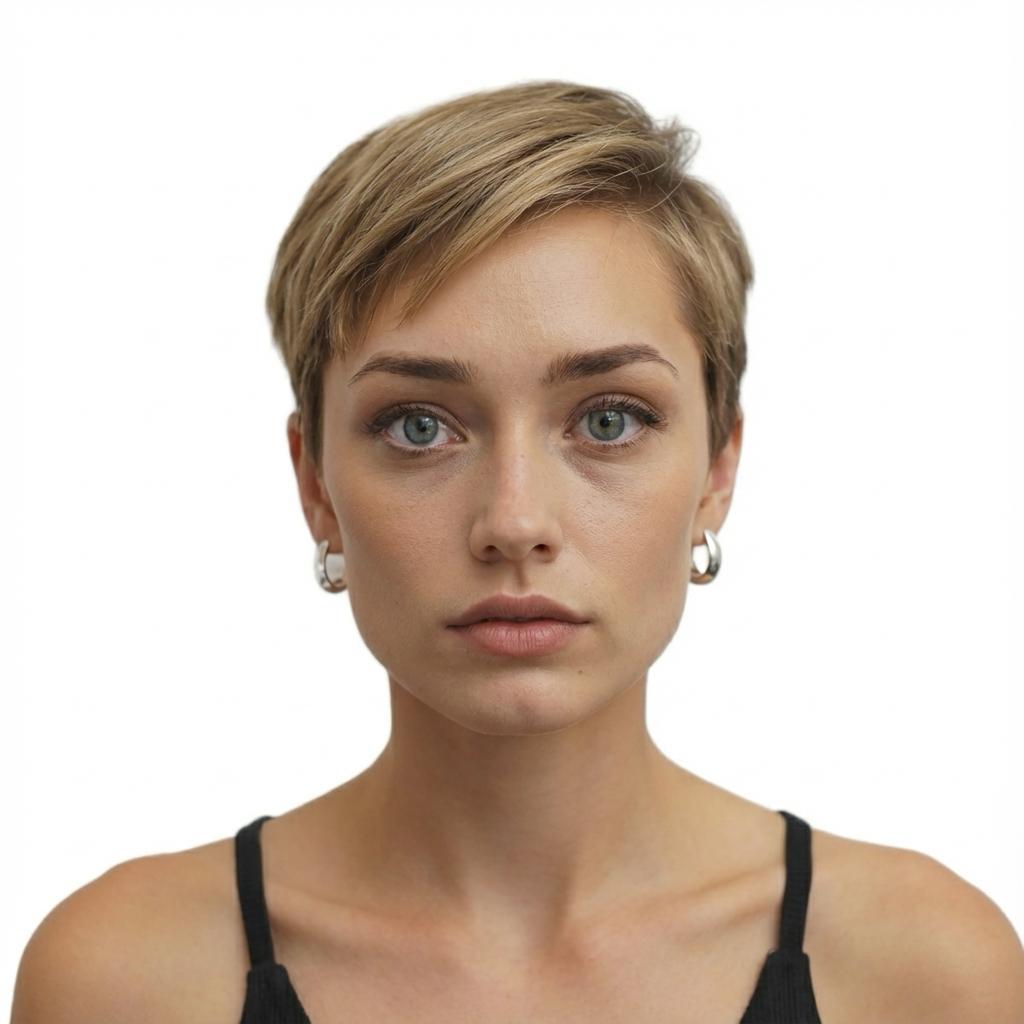
Eyes must be open and unobstructed by hair or glasses frames. The head must be held straight, gaze directed at the camera, with a neutral expression and mouth closed. Tinted lenses, reflections on lenses, or frames that cover any part of the eyes are not permitted. Shadows on the background and red-eye effects are not permitted.
Lighting. Use natural daylight from a window in front of you. Position yourself so the light falls evenly across both sides of your face. Avoid placing a window or bright source behind you, which casts your face into shadow.
Background. Tape or pin a plain light grey card or sheet on the wall behind you. Stand at least an arm's length away from the background so that your shadow does not fall on it.
Framing. Ask someone else to hold the phone at eye level, with the camera pointed straight at your face. Centre your head in the frame with a small margin above your hair.
Posture and expression. Sit or stand straight and keep your head level without tilting. Look directly into the lens. Hold a neutral expression with your mouth closed and eyes fully open.
Clothing. Avoid grey or white tops that blend into the background. Dark or strongly coloured clothing tends to produce the clearest separation.
Check before uploading. Zoom into the photo and confirm: the image is sharply focused throughout; both cheeks are evenly lit; no shadow falls on the background; eyes are fully visible; and the expression is neutral. Retake if any of these fail.
White or near-white background. A plain light grey background is required; white is not accepted. Using white card stock, a white wall, or a pale cream surface is one of the leading causes of Germany visa photo rejection.
Black-and-white photo. Black-and-white photos are rejected. Submit only full-colour photographs.
Photo older than six months. Photos taken more than six months before submission are rejected. A photo that was acceptable for a previous application may already be out of date.
Blurred, overexposed, or underexposed image. A photo that is blurred, overexposed, or underexposed will not be accepted. Check the image on a full-size screen rather than a phone thumbnail before printing.
Tinted glasses or reflections. Glasses with tinted lenses, lens reflections, or frames that cover any part of the eyes are not permitted. Wear clear lenses, or remove glasses entirely.
Face coverage outside the required range. The face must occupy 70–80% of the photo height, with the head held upright. A head that appears too small or too large in the frame, or that is tilted, fails this check.
Eyes not fully visible. Eyes must be open and fully visible; hair must not cover the face or eyes. Tuck or brush back hair before taking the photo.
Shadows on background or face. Shadows on the background and shadows across the face are not permitted. Use front lighting and stand away from the wall behind you to eliminate both.
Poor print quality. The photo must be sharp with sufficient contrast and printed on high-quality paper, either glossy or matte. Standard office printer output on copy paper is typically insufficient.
Missing photos. Two identical photos must be submitted. Submitting only one print, or two prints that differ in any way, causes the application to be returned.
A photo that fails the biometric check means rescheduling your appointment. The table below shows how the main options compare for getting a compliant Germany visa photo.
| Option | Cost | Time | Approval likelihood | Convenience |
|---|---|---|---|---|
| iShotAPhoto | Low | Quick | High when AI check passes | At home, any time, no appointment needed |
| Pharmacy or supermarket photo booth | Low to moderate | Quick | Varies; booths rarely enforce Schengen-specific background rules | Convenient location, limited control |
| Professional photo studio | Moderate to premium | Moderate | Higher when the studio is familiar with Schengen visa rules | Requires travel and availability |
| Street or station photo booth | Low | Quick | Varies | Widely available; lighting and background fixed by machine |
Costs and times vary by region.
Two visa types, one photo spec. Germany issues the Schengen visa (Type C) for short stays of up to 90 days and the National visa (Type D) for long stays over 90 days. Germany visa photo requirements are identical for both types.
Germany visa fee (current). Effective 11 June 2024, the Schengen visa fee is €90 for adults and €45 for children aged 6–11. Children under 6 are exempt. The increase was authorised under Commission Delegated Regulation (EU) 2024/1415 amending Regulation (EC) No 810/2009, with fee revenue going toward reducing appointment waiting times. Fees are non-refundable.
Germany visa processing time. For a Schengen (Type C) visa, standard processing is 15 calendar days, but can extend to 30–45 days during peak seasons or for certain nationalities. National (Type D) visa processing can take up to three months or longer. Apply well before your intended travel date.
Online application for national visas. From 1 January 2025, Germany's Consular Services Portal enables online document submission for 28 categories of national (Type D) visa at all 167 German visa sections worldwide. A shortened in-person appointment for biometric data collection remains required. The portal is not yet available in all countries.
Biometric data and the VIS. Fingerprints and your photograph collected at the visa appointment are entered into the EU Visa Information System (VIS) and shared with relevant Schengen member state authorities to process your application.
The Schengen 90/180-day rule. The Type C Germany Schengen visa counts days against the shared Schengen limit of 90 days within any 180-day period across all Schengen countries combined. Time spent in France, Spain, Italy, or any other Schengen state counts toward this total, not only time in Germany.
Religious head coverings. Head coverings are not permitted except for religious or medical reasons, and must not obscure the face in any way. The full face from chin to hairline must remain clearly visible.
Glasses. Glasses may be worn only if normally used, but tinted lenses are not permitted. Frames must not cover the eyes, and there must be no reflections visible on the lenses. Removing glasses eliminates the risk of rejection on this ground.
Children and fingerprints. Children under 12 are exempt from the fingerprint requirement at the visa appointment. For children, adult photo rules apply for face coverage and expression.
What size photo is required for a Germany visa?
The required photo size is 35 mm wide × 45 mm high (3.5 × 4.5 cm). Two identical photos must be submitted with the application.
What background colour is required for a Germany visa photo?
A plain, single-colour light grey background is required. White is not accepted. Light grey works best for dark hair; for lighter or grey hair, a slightly darker neutral grey provides stronger contrast between hair and background.
How recent does a Germany visa photo need to be?
The photo must have been taken within the last six months. A photo taken seven or eight months ago will be rejected regardless of quality.
What is the Germany Schengen visa fee?
Since 11 June 2024, the standard adult fee is €90 and the fee for children aged 6–11 is €45. Children under 6 are exempt. Fees are non-refundable if the application is rejected or withdrawn.
How long does Germany visa processing take?
Standard processing for a Schengen (Type C) visa is 15 calendar days, but may extend to 30–45 days during peak periods or for certain nationalities. National (Type D) visa processing can take up to three months or longer.
Can I apply for a German visa online?
From 1 January 2025, Germany's Consular Services Portal allows online document submission for 28 categories of national (Type D) visa at all 167 German visa sections worldwide. A shortened in-person appointment for biometric data remains required. For Type C Schengen short-stay visas, applicants currently submit through an embassy or authorised visa centre in person.
Are fingerprints required for a Germany visa?
Yes. Fingerprints are collected at your visa appointment and stored in the EU Visa Information System (VIS), shared with Schengen member state authorities for processing your application. They are re-collected every five years on subsequent applications. Children under 12 are exempt from this requirement.
Are glasses allowed in a Germany visa photo?
Glasses may be worn if normally used, but tinted lenses are not permitted. Eyes must be fully visible with no lens reflections and no frames blocking the eyes. Removing glasses for the photo is the most reliable way to meet this requirement.
What travel insurance is required for a Germany visa application?
Travel health insurance must cover at least €30,000 for medical emergencies, including hospitalisation and repatriation. The policy must be valid across the entire Schengen Area for the full duration of the trip.